
Email: ipexinfrastructures@gmail.com

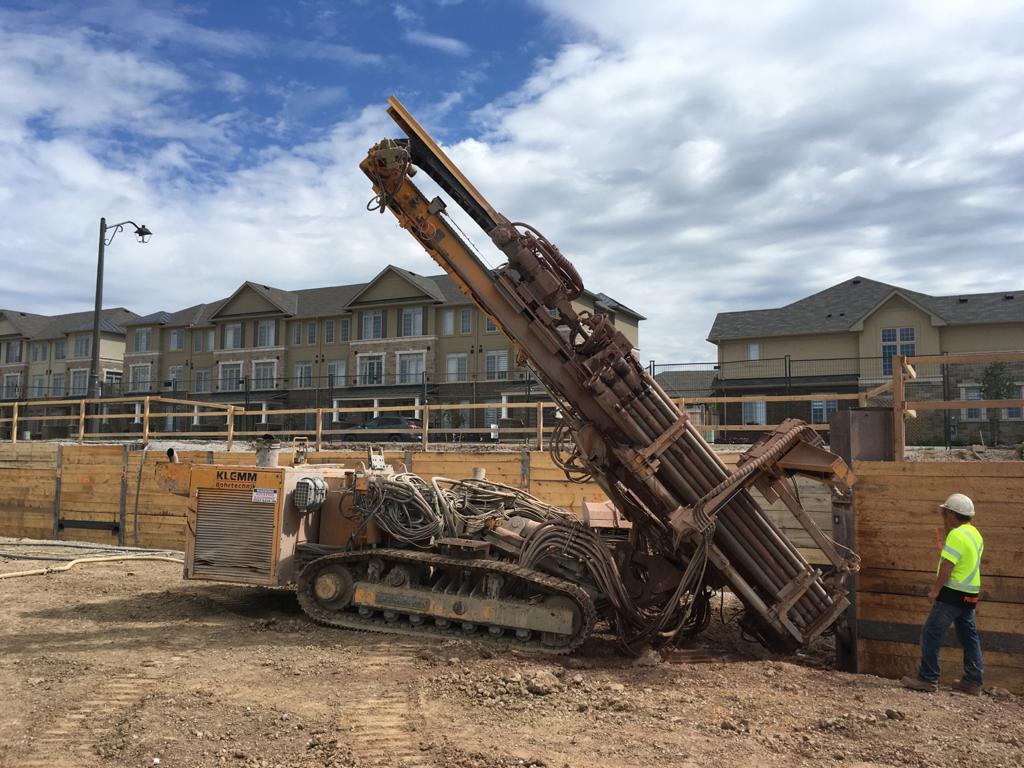
Anchored Shoring Systems
To stabilize deep excavations, lateral support systems are essential. Anchored shoring helps control lateral displacement of retaining structures and enables the safe construction of deep basements.
Anchors are typically installed by drilling into the ground, after which they are expanded at the embedded end. This expansion is achieved either mechanically or, more commonly, by injecting pressurized grout, forming a bulb that bonds with the surrounding soil.
Types of Anchors
Anchored shoring systems are broadly classified into:
- Stressed Anchors (Tiebacks): Made of high-strength steel bars or strands, these are grouted into drilled holes and prestressed to provide active resistance.
- Passive Anchors (Tie Rods): Typically connected to concrete anchor blocks or piles, these provide resistance without prestressing.
Anchors are often used with gravity retaining walls, where one or multiple tiers of anchors provide additional lateral stability.
Design Considerations
The stability and performance of anchored systems depend on several factors:
- Stiffness of structural members
- Depth of pile embedment
- Soil strength and stiffness
- Length of anchors or tiebacks
- Magnitude of anchor movement
Tieback systems are generally flexible, allowing active earth pressure to develop. However, with sufficient prestressing and structural rigidity, they can behave like restrained systems.
Anchor Classification
Anchors are categorized as:
- Temporary Anchors
- Permanent Anchors
Components of an Anchor
A typical anchor consists of:
- Free Length – Allows elongation during stressing
- Fixed Length – Bonded zone transferring load to soil
- Anchor Head – Transfers load to the retaining structure
Installation Process
The standard sequence includes:
Drilling to the required depth using casing or support fluids (water/bentonite)
Cleaning and flushing of the borehole
Primary grouting of the anchor
Secondary grouting (if required)
Grout setting/curing
Stressing of the anchor
Load Capacity
Anchors are typically designed for loads ranging from 20T to 120T, depending on:
- Number of strands
- Anchor length
- Soil conditions
Our Services
Provides structural support ensuring stability during deep excavation and construction
Contact Info
- +91 9891411511 / 011 47009142
- ipexinfrastructures@gmail.com