
Email: ipexinfrastructures@gmail.com

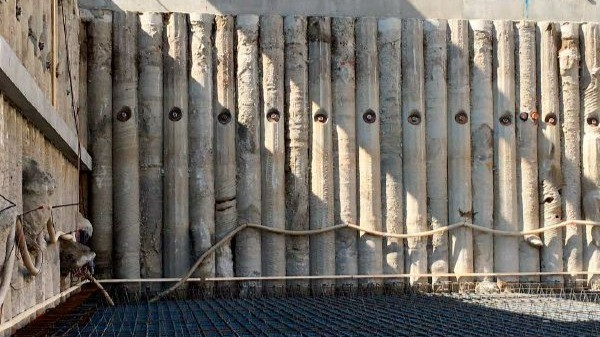
Secant Pile Wall
Secant pile walls are widely used shoring systems designed to provide effective ground retention and groundwater control for deep excavations. This system consists of interlocking reinforced concrete piles that form a continuous and structurally stable barrier.
Construction Method
A secant pile wall is formed by installing alternating “soft” (unreinforced) and “hard” (reinforced) concrete piles. The hard piles are constructed by cutting into the previously installed soft piles, creating an interlocking structure that ensures continuity and strength.
Typically, pile diameters range from 600mm to 1200mm, depending on project requirements, soil conditions, and excavation depth.
Key Features
Secant pile walls provide excellent soil retention and moderate to high water resistance. The interlocking system prevents soil movement and minimizes groundwater ingress, making it suitable for urban and confined construction sites.
This method also allows drilling through obstructions using specialized equipment, ensuring adaptability in challenging ground conditions.
Execution Process
The process begins with guide wall construction to ensure proper alignment. Soft piles are installed first, followed by hard piles which overlap into the soft piles.
Reinforcement cages are placed within the hard piles, and concrete is poured to complete the structure. The sequence ensures a continuous wall with enhanced strength and stability.
Limitations & Considerations
Secant pile walls may have limitations in very deep excavations due to potential alignment variations. Proper design and execution are essential to avoid gaps that may lead to water ingress.
Applications
Secant pile walls are commonly used in basements, metro projects, underground structures, and areas where controlled excavation and groundwater management are critical.
Our Services
Provides structural support ensuring stability during deep excavation and construction
Contact Info
- +91 9891411511 / 011 47009142
- ipexinfrastructures@gmail.com